
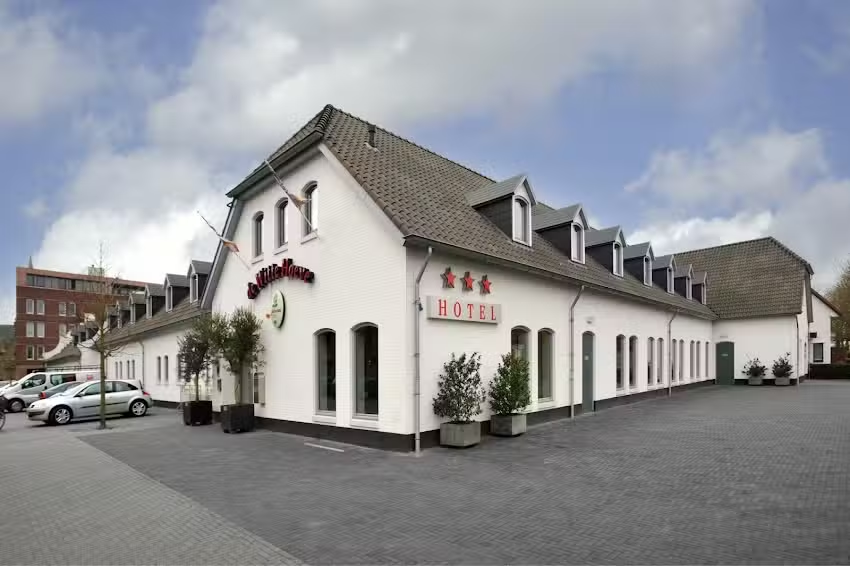
The White Farm
BackDe Witte Hoeve on Gasstraat in Venray, a name synonymous with both festive events and business meetings for years, has permanently closed its doors as of April 1, 2024. The new owner's decision to repurpose the building marks the end of an era for this well-known Limburg establishment. For travelers looking for accommodations in the region, it's important to know that this establishment is no longer operating as a hotel . What follows is an analysis of what De Witte Hoeve once was, based on the experiences of its last guests, as a look back at a business with two faces.
A Hybrid Model: Party Venue and Hotel
The core of De Witte Hoeve's identity lay in its dual function. It wasn't just another hotel in the region; it was primarily a large events center with nine halls that also offered guest rooms. This combination was both its greatest strength and its most significant weakness. For guests attending training sessions or weddings, it was an ideal form of hospedaje . The ability to go straight to a comfortable bed after a long day or a lavish party was a major advantage. Employers and organizers praised the venue for its well-prepared lunches and professional facilities for training days.
This dual role, however, inevitably led to conflict. Tourists or business travelers simply looking for a quiet place to stay could be unpleasantly surprised. Several guests reported noise from parties and events that lasted late into the night. One guest described hearing loud music directly below the room until 1 a.m., followed by the sound of furniture sliding. This kind of experience is a stark contrast to what one expects from a peaceful inn or posada . Better communication about planned events beforehand could have prevented much frustration; guests reported that sometimes they were only informed of an upcoming party upon arrival in their room via a piece of paper.
The Quality of the Rooms and Facilities
When it came to basic amenities, the rooms were mostly positive, but with some significant caveats. A consistent plus was the quality of the beds, which many described as "excellent" and comfortable, ensuring a good night's sleep. Housekeeping was also excellent, an essential aspect for any type of alojamiento .
However, there were also clear signs of deferred maintenance and somewhat dated furnishings. The rooms were sometimes perceived as dark. Practical problems were common, such as a shower stall that didn't close properly, resulting in a wet bathroom floor. Another frequently mentioned drawback was the air conditioning, which didn't work in some accommodations , causing temperatures to rise uncomfortably on hot days. The lack of standard amenities like a hairdryer was considered a shortcoming by some guests. This demonstrates that De Witte Hoeve, while functional, didn't offer the luxury of a modern resort or the complete independence of vacation apartments .
Service: Between Personal Help and Impersonal Distance
The service at De Witte Hoeve was a tale of contrasts. On the one hand, the staff was often described as friendly and very helpful. A notable and appreciated aspect of their flexibility was their meal policy. Because the establishment didn't have its own à la carte restaurant for individual guests (it only catered to group reservations), they were open to creative solutions. Guests could order food from local restaurants and enjoy it in the hotel dining room. The staff would then provide them with plates and cutlery, and they were even allowed to bring their own bottle of wine. This relaxed hospitality was a unique and strong point.
On the other hand, there was criticism of the impersonal nature of the service, particularly at the reception desk. Check-in was sometimes experienced as rushed and minimal. A bigger problem was that the reception desk was often unstaffed in the evenings and early mornings. This made it impossible for guests with complaints, for example, about noise, to find an immediate response. This lack of accessibility contributed to a feeling of distance, something you wouldn't expect in a smaller hostería where personal attention is often paramount.
Practical Plus Points
Besides the mixed experiences with the rooms and service, De Witte Hoeve had several undeniable advantages. Its location, within walking distance of Venray's city center, was ideal for guests wanting to explore the city. The availability of free parking was a significant plus. The breakfast was consistently praised as more than sufficient and with a very wide selection, ensuring a good start to the day. Motorcyclists even had the option of safely storing their motorcycles, a thoughtful extra.
The End of an Era
De Witte Hoeve was no standard hotel. It wasn't a serene villa or a modern department for a quiet holiday. It was a dynamic, sometimes noisy, hub where life was celebrated and business was conducted, and where you could also sleep. The balance between these two worlds was delicate and not always successful, leading to very different guest experiences. Its closure in 2024 marks the end of this unique, if sometimes problematic, player in Venray's hospitality industry. For the many organizations that called it home and the countless people who celebrated important life moments there, its closure leaves a void. De Witte Hoeve will be remembered as a place of contrasts: from hospitable flexibility to impersonal moments, and from festive joy to the frustration of a disturbed night's sleep.

